

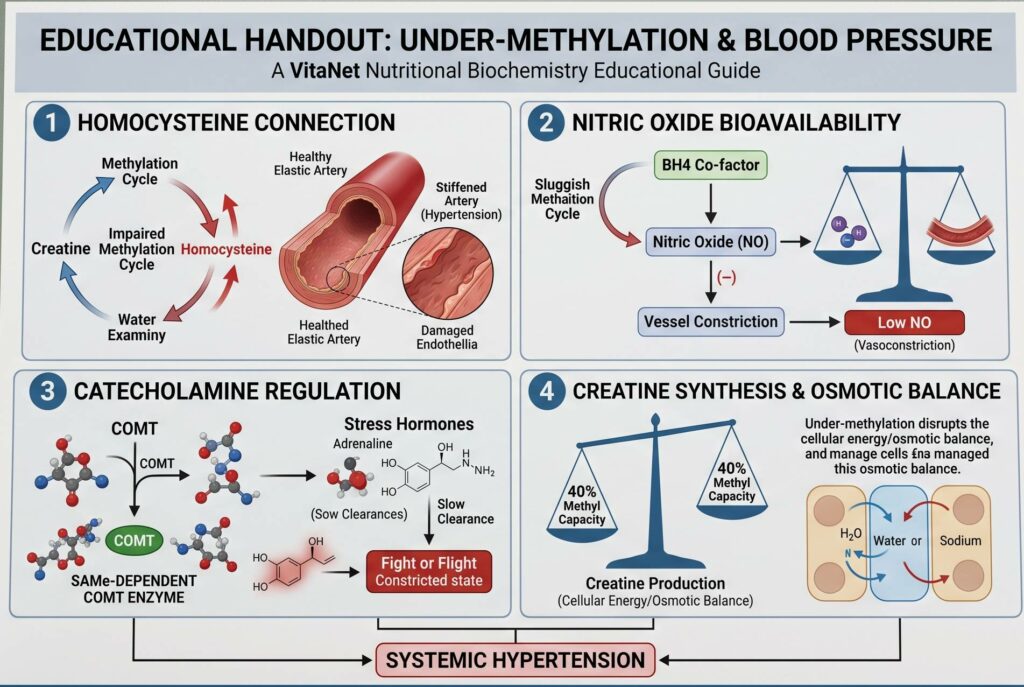
Does under methylation effect blood pressure?
Yes, under-methylation (hypomethylation) can have a significant impact on blood pressure through several biochemical pathways. When the methylation cycle is sluggish, it often leads to an accumulation of homocysteine and a deficiency in the universal methyl donor, SAMe (S-adenosylmethionine).
Here is how those imbalances specifically influence cardiovascular tone:
1. The Homocysteine Connection
The most direct link is through elevated homocysteine levels. When methylation is impaired, the body cannot efficiently convert homocysteine back into methionine.
- Arterial Stiffness: High homocysteine levels can damage the endothelial lining of the blood vessels, leading to reduced elasticity and “stiffening” of the arteries.
- Oxidative Stress: Homocysteine promotes the production of free radicals, which further damages vessel walls and contributes to systemic inflammation, a primary driver of hypertension.
2. Reduced Nitric Oxide Bioavailability
Methylation is essential for the production of BH4 (tetrahydrobiopterin), a critical cofactor for the enzyme that produces Nitric Oxide (NO).
- Nitric oxide is the body’s primary vasodilator – it tells blood vessels to relax and open up.
- If methylation is low, BH4 levels may drop, leading to “uncoupling” of nitric oxide synthase. This results in less nitric oxide and more superoxide (a toxin), causing blood vessels to remain constricted and raising pressure.
3. Catecholamine Regulation (The Stress Response)
The enzyme responsible for breaking down “stress hormones” like adrenaline and norepinephrine is COMT (catechol-O-methyltransferase).
- COMT is methyl-dependent, meaning it requires SAMe to function.
- In an under-methylated state, the body may struggle to clear these excitatory neurotransmitters. This can keep the nervous system in a “fight or flight” state, maintaining a higher heart rate and constricted peripheral blood vessels.
4. Creatine Synthesis and Electrolytes
The body uses a massive amount of methyl groups (roughly 40%) just to produce creatine.
- When methylation is poor, the body may prioritize homocysteine clearance over creatine production.
- Since creatine plays a role in cellular energy and osmotic balance, chronic deficiencies can indirectly affect how cells manage water and electrolytes, which are fundamental to blood pressure regulation.
Summary Table: Methylation and BP Factors
| Mechanism | Effect of Under-Methylation | Impact on Blood Pressure |
| Homocysteine | Levels increase | Increases arterial stiffness |
| Nitric Oxide | Production decreases | Prevents blood vessel relaxation |
| Adrenaline | Clearance slows down | Maintains “fight or flight” constriction |
| Endothelium | Increased oxidative stress | Damages vessel lining and function |
Under-methylation primarily elevates blood pressure by disrupting the health and flexibility of the vascular system. When the methylation cycle is compromised, homocysteine levels rise, leading to increased oxidative stress and structural damage to the arterial walls. This process is compounded by a decrease in nitric oxide bioavailability; without sufficient methyl donors to support necessary cofactors like BH4, the blood vessels lose their ability to dilate effectively, resulting in persistent constriction and higher systemic pressure.
Beyond direct vascular damage, under-methylation impacts blood pressure through the autonomic nervous system and metabolic demands. The COMT enzyme, which is responsible for breaking down stress hormones like adrenaline and norepinephrine, requires a steady supply of methyl groups to function. In a state of hypomethylation, these catecholamines can linger in the system, maintaining a “fight or flight” state that keeps the heart rate elevated and peripheral vessels tight. Furthermore, because the body prioritizes methyl groups for essential tasks like creatine synthesis, a sluggish cycle can disrupt cellular energy and electrolyte balance, further complicating long-term cardiovascular regulation.
Leave a Reply